
Should You Block a Blackmailer?
Why the Wrong Decision at the Wrong Time Can Escalate the Situation
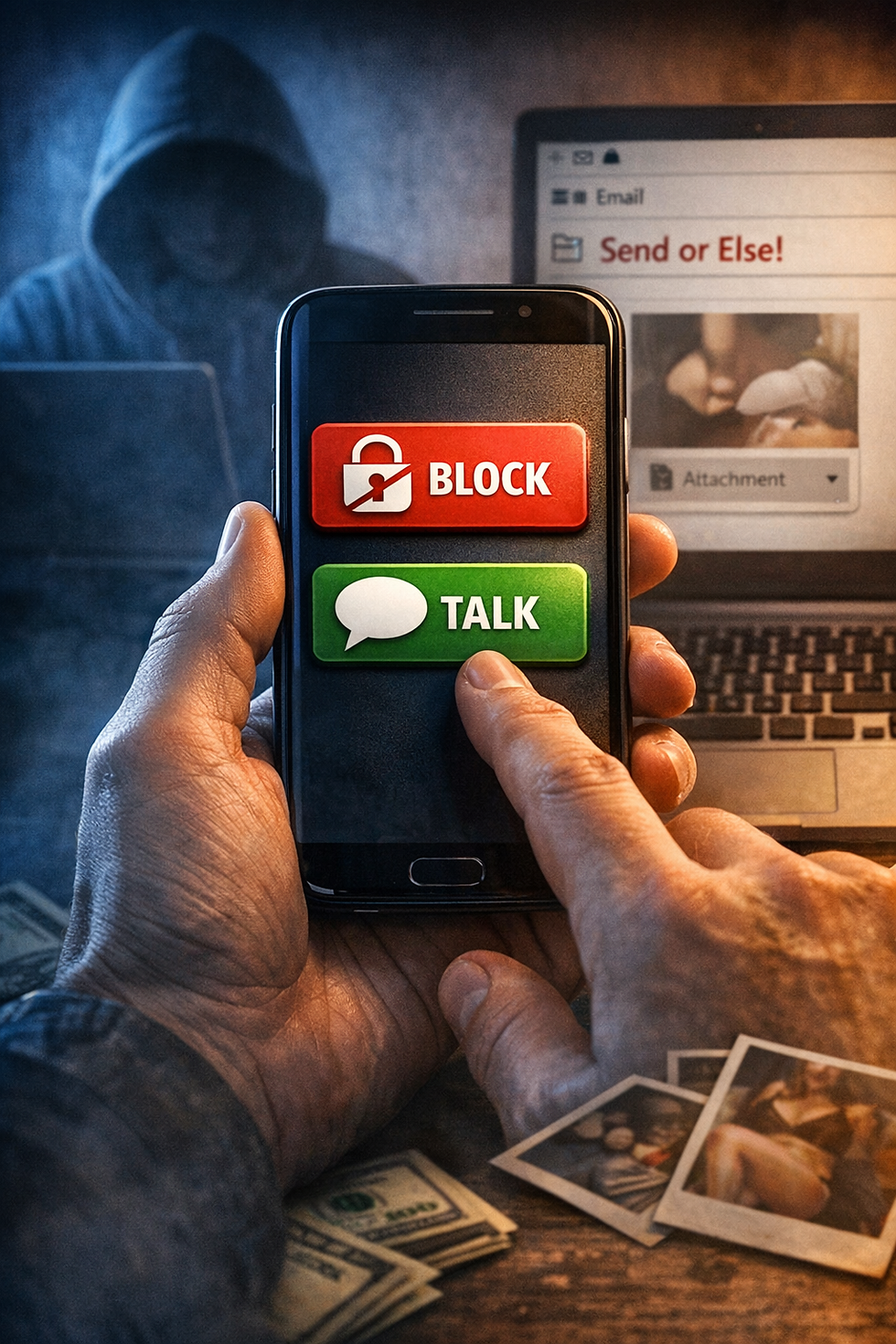
Blocking a blackmailer is often the first action people take.
It feels decisive. It feels like control. It creates immediate distance from the threat.
But in many blackmail and sextortion cases, blocking too early is not a solution—it is a shift in the dynamic. In some situations, it can make the problem more aggressive, not less.
The question is not simply whether you should block.
The real question is when, why, and under what conditions blocking becomes part of a structured blackmail defense and response strategy.

The Problem With Generic Blackmail Advice
Most general advice online treats blackmail like harassment. The recommendation is simple:
block the person, ignore them, and move on.
That works for spam.
It does not work for leverage.
Blackmail is built on a perceived advantage—something the other party believes they can use against you. That could be images, video, fabricated content, or simply the threat of exposure.
Blocking does not remove that advantage. It only removes your ability to see how it is being used.
What Blocking Actually Does During Blackmail
When you block a blackmailer, the situation doesn’t stop—it changes.
You lose visibility into their behavior, which means you no longer see how they are adjusting or whether they are escalating. At the same time, you give up any ability to influence the interaction, even in subtle ways. Most importantly, you create a reaction on the other side.
Blackmailers are not passive. They are watching how you respond, even if that response is silence. When communication stops suddenly, it forces them to make a decision about what to do next. That decision is often based on how they interpret your behavior in that moment.
Case Pattern: Immediate Escalation After Blocking
In a typical sextortion case, someone receives a threat and blocks immediately.
Within minutes, a new account appears. The tone shifts almost instantly. What began as an attempt to “resolve” the situation becomes more aggressive. The language becomes shorter, more direct, and more threatening.
What changed was not the leverage.
What changed was the perception of control.
From the blackmailer’s perspective, blocking signals panic or loss of influence. Either one can trigger escalation.
Case Pattern: Contact Expands, Not Contracts
In another scenario, an individual blocked the blackmailer on the original platform, assuming that would end the interaction.
Within hours, the same person was contacted through email, then a different social platform. The blackmailer had already gathered enough information to locate additional channels.
Blocking one path did not end the situation—it widened it.
This happens more often than people expect, particularly when usernames, email addresses, or social profiles overlap.
Case Pattern: Silence That Feels Like Resolution
There are also cases where blocking appears to work.
The messages stop. No new accounts appear. Days pass without contact.
That silence creates a sense of relief, and in some situations, it may indicate the individual has moved on.
But not always.
In many cases, the blackmailer returns later, sometimes from a different account or with a different tone. Without preserved communication or context, it becomes difficult to understand what has changed or how to respond.
Silence is not confirmation of resolution.
It is simply the absence of communication—for now.
Why Visibility Matters More Than Comfort
Communication with a blackmailer is uncomfortable by design.
But it is also informative.
Every message provides insight into how the situation is being managed on the other side. Patterns begin to emerge—how quickly they respond, how they escalate, whether their threats are consistent or exaggerated.
That information is critical.
When communication is cut off too early, that visibility disappears. Decisions then become reactive, based on fear or assumption rather than what is actually happening.
The Role of Timing In An Active Blackmail
Blocking is not inherently wrong.
It is often simply used at the wrong time.
When blocking happens before the situation is understood, it removes the ability to evaluate risk accurately. It is usually done at the peak of stress, when threats feel most urgent and the instinct is to shut everything down.
That is precisely when visibility is most valuable.
When blocking is used later—after the interaction has stabilized and the situation has been assessed—it can be part of a controlled response.
The difference is not the action itself.
It is the timing.
Case Pattern: Blocking After Payment
One of the more difficult situations occurs after payment has been made.
Someone sends money, then immediately blocks, hoping to close the situation.
In many cases, the opposite happens.
New accounts appear. The tone becomes more aggressive. The blackmailer claims the payment was incomplete or introduces new demands.
From their perspective, the situation has just been confirmed as workable.
Blocking at that point does not resolve anything—it interrupts a process that they are now motivated to continue.
What a Structured Approach Looks Like
A more effective approach begins with slowing the situation down.
That means preserving communication, understanding what is actually known versus what is being claimed, and observing how the interaction is developing.
From there, communication can be managed deliberately. Not more communication, but better communication. Not emotional responses, but controlled ones.
This is where blackmail defense and response becomes critical.
The goal is not to engage unnecessarily, but to maintain enough visibility and control to guide the situation instead of reacting to it.
When Blocking Is the Right Move
Blocking can absolutely be the right decision.
But it works best as a closing action, not an opening one.
When the interaction has stabilized, when the risk has been assessed, and when communication is no longer providing useful information, blocking becomes part of a controlled strategy.
At that point, it is no longer reactive.
It is intentional.
Your Takeaway
Blocking a blackmailer feels like taking control.
In many cases, control comes from doing the opposite—slowing down, observing, and responding deliberately.
Blackmail is not just about what is threatened.
It is about how the situation is managed.
And the first decision you make often determines how the rest of it unfolds.


Comments